A GENERAL GUIDE
Why clear ice.
A short guide.
Clear ice is not a magic trick or a marketing label. It is just ice without the trapped air and impurities that make freezer ice cloudy. Below is a general guide to why people choose it for certain drinks. We make and deliver it in KL and Selangor, so we have a side of the story too, but the principles here are common knowledge in food science and the cocktail world. Use this as background, not as a sales pitch.
More than just prettier.
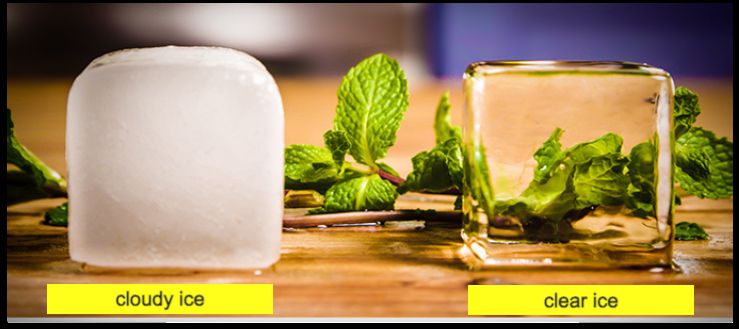
A standard freezer ice cube has a white core. That core is usually a mix of trapped air, dissolved minerals from tap water and absorbed odours from whatever else lives in the freezer. As the cube melts in your drink, a small amount of all that ends up in your glass.
Clear ice has much less of it. The clarity is a byproduct of slower, one-direction freezing that pushes impurities out of the ice as it forms, instead of trapping them inside.
How it tends to change the taste.
A few things shift when the ice is cleaner.
- Fewer off-flavours. Freezer ice tends to pick up the smell of whatever is around it. A clean clear cube tastes much closer to nothing, which is what you usually want from ice.
- Less mineral leach. Tap-water ice releases calcium, magnesium and chlorine as it melts. Clear ice starts from filtered water and freezes most impurities out before the cube reaches your glass.
- Slower dilution. A denser, air-free cube melts more slowly, so the first sip and the last sip taste closer to each other. With a cloudy cube, a drink can water down noticeably in ten minutes or so.
Generally a slower melt.
A clear cube can last considerably longer than a standard freezer cube of the same size in the same glass. The commonly cited figure is up to three times longer. Less trapped air means a denser block, and less surface area touches the liquid relative to the cube's mass.
A 5.5 cm sphere tends to last longer still. Spheres have the smallest surface area to volume ratio of any solid shape, which is why they are often chosen for neat pours where slow chilling and minimum dilution matter.
Where it tends to matter most.
This part is general guidance, not rules. Different drinks, different preferences. Use what makes sense.
Whisky neat
A clear sphere or 5 cm cube is a common choice. Chills the spirit while keeping dilution slow. Single malts, bourbons, rye.
Old Fashioned, Negroni, Manhattan
A 5 cm cube is the usual pick. Spirit-forward stirred cocktails can dilute fast on cloudy ice. A clear cube tends to hold the build together longer.
Highballs and long pours
A clear cylinder (4 cm by 11 cm) is often used. Sits tall in the glass and chills the pour evenly. Japanese highball, gin and tonic, vodka soda.
Cold brew, iced latte, espresso tonic
A 5 cm cube or column works well. Speciality coffee is sensitive to off-flavours, so cleaner ice tends to help the bean show through.
Iced tea, kombucha, mocktails
Same logic. When the drink is the focus, the ice ideally adds nothing but cold.
Engraved cubes for events
Hotel signatures, wedding monograms, brand launches. The clear cube acts as the canvas. See engraving examples →
Want to see how it is made?
The clarity is not a trick. It is the result of a 72 hour directional freezing process plus hand-finishing. See the full 72-hour process →
FAQ
Does clear ice actually make a drink taste better?
Yes. Regular freezer ice traps air, freezer odours and dissolved minerals. Those leach into the drink as the ice melts, dulling the flavour profile of a spirit, coffee or cocktail. Clear ice is essentially mineral-free and odourless, so the drink tastes how it was meant to taste.
How much slower does clear ice melt?
Up to three times slower than standard freezer ice in the same glass. Less trapped air means a denser structure with less surface area exposed to the liquid, so chilling is preserved and dilution is delayed.
Is clear ice worth it for cocktails?
Yes, especially for spirit-forward cocktails like Old Fashioneds, Negronis and whisky on the rocks where any off-flavour or fast dilution ruins the build. A 2 inch clear cube or 5.5 cm sphere is standard for these.
What is the actual difference between clear ice and regular ice?
Regular ice freezes from all sides at once. As water freezes, it pushes air and minerals toward the centre. Trapped, those create the cloudy core and off-flavours. Clear ice is frozen directionally, so air and minerals are pushed out as water turns to ice. The result is optically pure ice with no trapped impurities.
Can I make clear ice at home?
Sort of. The cooler-method trick can give a small batch of partial clarity, but the result is inconsistent, requires a freezer dedicated to the job for 24+ hours, and still needs hand cutting. Most home freezers cycle between temperatures and contaminate the ice with food odours. Buying clear ice is simpler, faster and gets you bar-grade results immediately.